Bridging Global Surgery, Social Justice, and Pelvic Health Care
Dr. Lina Roa is a urogynecologist whose path has taken her from Colombia to Canada, through clinical training across four provinces, and into a fellowship at Harvard Medical School focused on global surgery and social change.
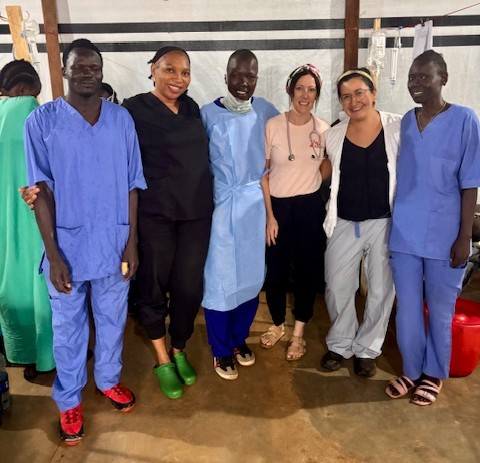
Her work in humanitarian and low-resource settings — where she is often the only specialist available — has shaped her approach to surgical care and deepened her commitment to reaching underserved communities, both globally and here in Canada. In this conversation, she reflects on what drew her to the intersection of surgery and social justice, and what she's learned along the way.
Can you share your story with us? Where you are from, your training and where you completed it, and any mentors or influences who guided you toward this field.
LR: I was born and raised in Colombia, but due to the country’s political instability, my family migrated to Canada when I was a teenager. That move set me on a path of constant learning and adaptation. My education took me across the country: undergraduate studies at the University of Calgary, medical school at the University of Toronto, residency at the University of Alberta, and fellowship training at the University of British Columbia. Along the way, I learned the fundamentals of patient centered medicine to respond to the needs of individual patients.
Yet as my clinical skills grew, so did my awareness of what was missing. I saw how many of the illnesses and inequities I encountered were rooted not only in biology, but in the structures of health systems and society itself–areas we are not encouraged to focus on during surgical training. Seeking answers, I pursued further training, completing a Master of Public Health at Harvard T.H. Chan School of Public Health, followed by a three-year Paul Farmer Fellowship in Global Surgery and Social Change at Harvard Medical School. During this time my research focused on improving surgical care, through a lens of social justice, with a commitment to prioritizing those who have historically been marginalized.

What continues to motivate you and sustain your commitment to this work?
LR: My motivation is shaped by what I witness around me each day. In the headlines and in lived realities–from Sudan and Palestine to Ukraine, the United States, and even within our own communities–I see the steady erosion of human rights, growing barriers to health care, and the narrowing of reproductive freedom. These are not distant crises; they are deeply human ones.
Yet even in the midst of this, I am continually struck by something else: the quiet persistence of people who refuse to accept injustice as inevitable. Health care workers who continue to show up, advocates who speak when it is costly to do so, and patients who insist on dignity despite adversity. Their courage sustains me. It is this collective resolve that drives my commitment to social justice, and to providing high-quality surgical care to those who have been systematically underserved.

In what ways does your work abroad differ from your practice in Canada?
LR: Working in humanitarian and low-resource settings requires a slightly different approach to care. Diagnostic tools, operating room equipment, and pre- and post-operative supports are often limited and different, making adaptability, creativity, and comfort with uncertainty essential skills. In many of these contexts, I am frequently the only specialist available, reflecting the profound global shortage of surgeons.
Patients often present with complex and advanced conditions shaped by poverty and systemic neglect, including severe malnutrition, anemia, and chronic untreated comorbidities. I often encounter clinical presentations that are rare in high-income settings–such as obstetric fistulas and severe injuries related to sexual violence–often compounded by contextual challenges like active conflict, displacement, and psychological trauma. The scarcity of resources for safe pre- and post-operative care creates challenges that differ markedly from those we face in Canada, and demands not only technical skill, but humility, resilience, and a deep respect for the realities of patients’ lives.
What lessons have you gained from your work abroad, and how has this influenced your practice here in Canada?
LR: These experiences have deepened my appreciation for what can appear to be endless resources in Canada, while also sharpening my awareness of the inequities that persist within our own health system. A substantial proportion of patients living with pelvic floor disorders in Canada do not access care, wait for way too long–or are unaware that effective care even exists. Those most affected are often individuals with lower levels of formal education, people facing socioeconomic barriers, and patients living in rural or remote communities.
This recognition has strengthened my commitment to supporting underserved immigrant populations and expanding access beyond urban centres and to supporting the delivery of care in rural and northern communities, where need is often greatest and services are most limited.
What advice might you offer to early-career urogynecologists?
LR: I am an early-career urogynecologist, so I’m not entirely sure I’m qualified to dispense too much wisdom yet. That said, when discussing my global health work, I often hear from surgeons further along in their careers that they wish they had engaged in this type of work at some point in their careers.
So, if working abroad or in underserved settings at home is something you’re even a little curious about, my advice is to try it. There will never be a perfect time–there are always many other pulling responsibilities at home–but make the time anyway, and it will be worth it!